

Reviewed · 5-DAY EXPERIENCES
5 Day Private Tour of Tigers, Taj Mahal and Palaces from Cochin
Tigers and the Taj in one tight loop. I like this route because you get sunrise Taj Mahal time with less hassle, and then you’re set up for Ranthambore tiger safaris with a naturalist onboard. It’s the kind of itinerary that works well when your India window is short but your list is long.
I also appreciate the private nature of the experience: you travel with your own English-speaking local guides and chauffeur-driven transport between cities, plus airport/port handoffs built into the schedule. In the real world of India timing, having named guide support (I’ve seen Prashant, Vijay, and Rajni praised for site-by-site explanations) makes the big days easier to handle.
One thing to think about: this is a packed plan with early starts and long drives, and the safari rides are shared (jeep/canter, sometimes a 20-seater canter). If you want maximum downtime, or you hate being in a crowd at once, you’ll feel it.
In This Review
- Key things worth noting before you go
- How this Kochi-to-Mumbai route fits a cruise schedule
- Day 1 in India: from Kochi port to Delhi by commercial flight
- Delhi in one half-day: Humayun’s Tomb, Qutub Minar, and the Sikh temple
- Humayun’s Tomb: the Mughal mood-setter
- Qutub Minar: soar high, then look for the details
- Gurudwara Bangla Sahib: calm, white stone, and a central pool
- India Gate and the government core: monuments in a modern city
- The Agra drive at the end of Day 2
- Agra at sunrise: Taj Mahal timing plus Agra Fort
- The Taj Mahal: why the morning block matters
- Agra Fort: the Mughal power base next
- Overnight logistics: heading toward Ranthambore
- Ranthambore tiger country: two safaris and what to expect
- Morning safari: focus and spacing
- Afternoon safari: second chance without changing plans
- Shared jeep/canter: plan for the group dynamic
- What to wear in the reserve
- Jaipur’s Pink City: Sheesh Mahal, City Palace, and Jantar Mantar
- Sheesh Mahal and the mirror palace style
- Jal Mahal photo stop: water palace from the outside
- Hawa Mahal photo stop: the honeycomb façade
- City Palace: courtyards, royal residence, and blended eras
- Jantar Mantar: star math in stone
- Finish in Mumbai: flight handoff to your ship
- Price and value: what you’re really paying for
- Guides, drivers, and why it can make or break the trip
- Who this tour is best for
- Should you book this Kochi-to-Mumbai Tiger, Taj, and Palaces tour?
- FAQ
- Where does the tour start, and where does it end?
- Are domestic flights included?
- Is this really a private tour?
- What safaris do you do in Ranthambore?
- What if a shared jeep safari is not available?
- Are entrance fees and guides included?
- What meals are included?
- Do I need to pay for a video camera at monuments?
- What should I wear for the tiger reserve?
- What documents do I need for the flights?
Key things worth noting before you go

- Sunrise Taj Mahal with parking-to-site battery-bus/golf-cart return
- Two Ranthambore safaris (morning and afternoon) plus an English-speaking naturalist
- Private local guides for Delhi, Agra, and Jaipur sightseeing
- 5-star hotels for 4 nights on twin sharing, with meals mapped to the plan
- Airport and port transfers that keep you linked to your cruise schedule in Mumbai
- Budget a few extras like monument video camera fees (approx. $6) and holiday gala dinners not included on X-mas/New Year’s Eve
How this Kochi-to-Mumbai route fits a cruise schedule

This is built for cruise travelers who dock in Kochi (Cochin) and want India’s headline moments without losing days. You start with Kochi port pick-up, then fly domestically to Delhi, move through Agra and Jaipur, and end in Mumbai with a handoff to your ship. That sequencing matters because India’s distances are real, and in a 5-day window you want fewer “figure it out yourself” gaps.
The tour also stays structured even though it’s private. You have a plan with guided sightseeing and scheduled safari blocks, but you’re not sharing your van with strangers all day. For many people, that’s the sweet spot: group logistics handled, but you still get personal attention.
Day 1 in India: from Kochi port to Delhi by commercial flight
Your first day is basically a logistics win. After pick-up from the Kochi cruise port, you transfer to the local airport and take an economy class commercial flight to Delhi. When you land, a chauffeur meets you and gets you to your Delhi hotel.
Why I like this approach: it cuts the long overland grind that can eat an entire day in India. It also means you arrive with enough energy to reset—especially important if your ship timetable is tight.
A practical note: airport timing in India can be affected by traffic and daylight. The tour says transfer durations are approximate and depend on traffic, so I’d mentally plan for some variability rather than expecting everything to run to the minute.
More private tours, just your group and a local Kochi guide.


Delhi in one half-day: Humayun’s Tomb, Qutub Minar, and the Sikh temple
Delhi here is a concentrated hit of Mughal and early Islamic-era icons, plus a major Sikh place of worship—enough to get your bearings fast, without trying to do the whole city.
Humayun’s Tomb: the Mughal mood-setter
You visit Humayun’s Tomb, a UNESCO World Heritage site tied to Mughal Emperor Humayun. This stop works because it’s not just a pretty building. It’s an early template for later Mughal architecture, and it helps you understand what people were aiming for when the Taj Mahal era arrived.
Admission is included, which helps keep the day smooth.
A handful more Kochi tours and Kerala day trips to think about
- 5 Days Luxury Kerala Tour with Houseboat Experience
★ 4.5 · 279 reviews - 5 Days Private Kerala Tour Package by Saffron India Tours
★ 4.5 · 51 reviews - 5 Days Kerala Tour with Private Car Houseboat Munnar and Thekkady
★ 5.0 · 25 reviews - 5 Day Private Tour of Tigers, Taj Mahal and Palaces from Cochin
★ 5.0 · 18 reviews - 5 Days Kerala Tour Package With 4 Star Stays & Private Houseboat
★ 5.0 · 12 reviews - Cochin: 5-Day Kerala Tour with Munnar, Thekkady and Alleppey
★ 4.2 · 9 reviews
Qutub Minar: soar high, then look for the details
Next up is Qutub Minar, another UNESCO World Heritage site. Even if you don’t read every inscription, you’ll notice the scale and the purpose: it’s a victory minaret and a landmark that dominates the skyline. This is the kind of stop where a guide’s explanations can turn a photo op into something you actually remember.
Gurudwara Bangla Sahib: calm, white stone, and a central pool
Then you get Gurudwara Bangla Sahib—a Sikh temple known for its bright white building, a golden dome, and a pool inside the complex where devotees gather. This is a nice counterbalance to the fortress-and-tomb feel of the earlier sights.
It’s listed as free admission, so your time here stays focused on walking and observing, not ticket lines.
India Gate and the government core: monuments in a modern city
You also pass India Gate, a 42m-high memorial arch designed by Lutyens. After that, you see the area associated with the Indian Parliament handover and visit Rashtrapati Bhavan (President House). Some of these stops are brief, so treat them as context builders—how the layers of power shift from empire to independent India.
The Agra drive at the end of Day 2
After Delhi sightseeing, you drive to Agra (about 3 hours) and check into your hotel. This pacing is important: Agra needs an early start later, so you’re not burning time on extra stops before Taj day.
Agra at sunrise: Taj Mahal timing plus Agra Fort
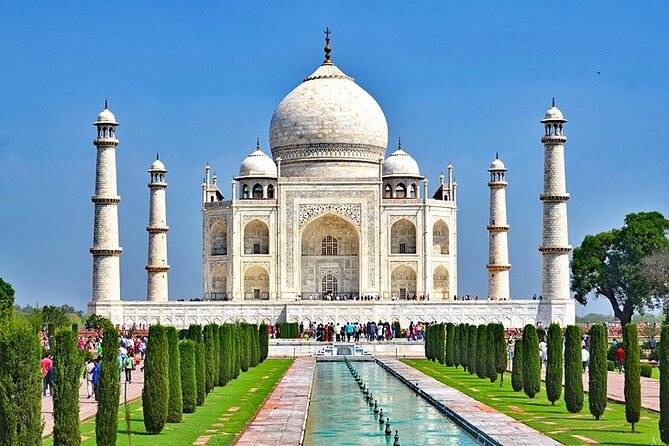
Day 3 is the headline day. You go early for the Taj Mahal at sunrise to avoid heavier crowds and daytime heat. Even if you’ve seen the Taj in photos, the physical presence hits different when the light is soft and the air is cooler.
The Taj Mahal: why the morning block matters
This visit includes admission fees, plus a big practical extra: there’s a battery bus/golf cart return ride from the Taj Mahal parking area. That matters because the Taj area can involve walking distances you may not want after a hotel breakfast and a pre-dawn schedule.
What I like about a sunrise approach: your photos look better, and your brain stays clear. The Taj is a lot to process—so you’ll enjoy it more if you’re not exhausted.
Agra Fort: the Mughal power base next
After Taj time, you visit Agra Fort, another UNESCO World Heritage site. This stop gives you the “inside the empire” angle—where rulers lived and operated. It also helps you connect the visual drama of the Taj with the political world that made it possible.
Overnight logistics: heading toward Ranthambore
In the afternoon you drive about 5 hours to Ranthambore Tiger Reserve. This is a long move, but it places you in position for two safari opportunities the next day.
Ranthambore tiger country: two safaris and what to expect
Ranthambore is the reason many people sign up, and this itinerary gives you a meaningful chance by scheduling both a morning and an afternoon safari. You ride in a shared jeep/canter, and you’ll have an English-speaking naturalist along for the safaris.
Morning safari: focus and spacing
The morning safari is listed as about 3 hours. The benefit of the morning block is practical: you’re out in lower heat, and you’re more likely to feel alert rather than sluggish. Also, early in the day, wildlife viewing can feel more active.
Afternoon safari: second chance without changing plans
The afternoon safari is another about 3 hours, also with a shared vehicle. If the morning doesn’t deliver the moment you hoped for, the second outing increases your chances without requiring you to scramble for extra tickets on your own.
Shared jeep/canter: plan for the group dynamic
Since you’re in a shared vehicle, you’ll be coordinating viewpoints with other people. That can be a drawback if you’re picky about where you sit or how you angle your camera. But it’s also part of how the reserve operates.
Also keep in mind: the tour provides a contingency. If shared jeeps aren’t available, safaris switch to a shared canter (20-seater van). That’s good to know because it changes the “feel” of the ride—more people, different seating, different viewing.
What to wear in the reserve
This tour gives clear guidance: wear jungle colors that blend in—khaki, brown, and olive green are suggested. It’s a respectful approach that also makes sense for comfort in warm weather. Bright colors can be harder on the animal side, and you’ll feel more at ease when you’re dressed for the environment.
Jaipur’s Pink City: Sheesh Mahal, City Palace, and Jantar Mantar
Day 4 ends with the drive into Jaipur (about 3 hours), and Day 5 delivers the classic Jaipur landmarks.
Sheesh Mahal and the mirror palace style
You start with Sheesh Mahal (mirror palace). This stop tends to feel special because Jaipur’s palace architecture isn’t just about walls—it’s about light, decoration, and how design turns into atmosphere. Admission is included.
Jal Mahal photo stop: water palace from the outside
Next is a photo stop at Jal Mahal (Water Palace). This isn’t described as a long visit with interior time, so think of it as a perspective moment: the palace sitting in water is visually memorable, and a quick stop keeps the day moving toward the main monuments.
Hawa Mahal photo stop: the honeycomb façade
You also do a photo stop at Hawa Mahal, the famous Palace of Winds with its pink honeycomb façade. Again, this is short—about 15 minutes—so arrive ready to shoot, then move on.
City Palace: courtyards, royal residence, and blended eras
After that, you visit City Palace of Jaipur, the residence of the royal family. This stop includes admission and is listed as about 1 hour. What makes City Palace worth your time is its variety: courtyards, gardens, and palace buildings from different periods. It’s a good place to slow down and absorb how the city’s royal story evolved.
Jantar Mantar: star math in stone
Finally you visit Jantar Mantar, a UNESCO World Heritage observatory. The geometric structures are built to track celestial movement, and even with limited time, you can feel the intent behind the shapes. Admission is included.
Finish in Mumbai: flight handoff to your ship
In the early evening you go from Jaipur to Jaipur airport and fly to Mumbai on a commercial economy flight. When you arrive, you get met and transferred to your ship with Kochi port pick-up and drop-off at Mumbai Port included. It’s a practical ending: you’re not stuck finding transport at the last minute after a full day of monuments.
Price and value: what you’re really paying for

At $1,668 per person, this isn’t a budget trip. But the price lines up with what’s included: private transport, 4 nights in 5-star hotels (twin sharing), domestic commercial flights (Kochi–Delhi and Jaipur–Mumbai), professional guides, entrance fees, two Ranthambore safaris, and safari-support staffing including an English-speaking naturalist. Add unlimited bottled water and the Taj Mahal battery bus/golf cart return ride, and the “hidden stress” of planning starts to disappear.
So I look at it like this: you’re paying to compress distance and decision-making. This matters most for cruise travelers who can’t add extra days.
That said, the high price also means you should confirm your priorities match the schedule. If what you want most is slow travel and flexible pacing, this itinerary is built for momentum—Delhi to Agra to Ranthambore to Jaipur, all in 5 days.
Guides, drivers, and why it can make or break the trip
One of the most praised parts of this experience is the human side: guides and drivers who keep the day organized and explain what you’re seeing.
In past experiences linked to this operator, I’ve seen names like Prashant and Vijay praised for strong explanations around Agra sites, and Rajni credited for doing an excellent job from port pickup through the end. On the driving side, names such as Pradeep, Jewan, Basant, and Prasant show up with praise for safe, timed transport across busy streets.
You can’t guarantee which guide you’ll get, but the pattern is consistent: this tour’s quality is tied to local, English-speaking support, not just the big ticket sights.
Who this tour is best for
This works especially well if:
- You’re a cruise passenger docked in Kochi and want to end the tour with a transfer to your ship in Mumbai
- You want the Golden Triangle sights plus Ranthambore without building the plan yourself
- You’re comfortable with early starts (sunrise Taj) and long drives between cities
- You like having a guide who can make stops feel less like random landmarks
You might look elsewhere if you:
- Need a calmer pace with more free time
- Don’t want shared safari vehicle dynamics
- Are sensitive to tight scheduling around sunrise and multi-city travel days
Should you book this Kochi-to-Mumbai Tiger, Taj, and Palaces tour?
If your goal is to pack in the major highlights—Delhi, Agra, Jaipur, and Ranthambore—while keeping logistics handled end-to-end, I think this is a solid choice. The combo of sunrise Taj Mahal, two Ranthambore safaris, and private guided sightseeing is a strong match for a 5-day cruise window.
Book it when you’re okay trading downtime for focus, and you’re happy to be out early and riding shared safari vehicles. Skip it if you want slow travel or a schedule that leaves lots of blank space.
FAQ
Where does the tour start, and where does it end?
The tour starts with pick-up from the Kochi (Cochin) cruise port and ends with transfer to your cruise ship in Mumbai Port after arriving from Jaipur by flight.
Are domestic flights included?
Yes. The tour includes economy class commercial flights from Kochi to Delhi and from Jaipur to Mumbai.
Is this really a private tour?
Yes. It’s described as private, with only your group participating.
What safaris do you do in Ranthambore?
You do two jungle safaris in Ranthambore Tiger Reserve: one in the morning and one in the afternoon, using a shared jeep/canter.
What if a shared jeep safari is not available?
If shared jeeps aren’t available, safaris are provided in a shared canter (20-seater van).
Are entrance fees and guides included?
Yes. The tour includes entrance fees for the mentioned sights and national park, plus professional private local guides for sightseeing and an English-speaking naturalist during safaris.
What meals are included?
Meals are included as specified in the itinerary, and you also get unlimited bottled water. Food and drinks beyond what’s specified aren’t included.
Do I need to pay for a video camera at monuments?
Yes. Video camera fees (approx. US$6) are not included for monuments.
What should I wear for the tiger reserve?
You should wear jungle colors that blend with the forest, with khaki, brown, and olive green suggested.
What documents do I need for the flights?
You need a current valid passport on the day of travel, and a passport copy is required for booking the domestic flights. The tour also notes that you should be vaccinated and carry your COVID vaccination certificate.
More 5-Day Experiences in Kochi
- 5 Days Luxury Kerala Tour with Houseboat Experience
★ 4.5 · 279 reviews - 5 Days Private Kerala Tour with Houseboat by Sanguine Holidays
★ 5.0 · 114 reviews - 5 Days Private Kerala Tour Package by Saffron India Tours
★ 4.5 · 51 reviews - 5 Days Kerala Tour with Private Car Houseboat Munnar and Thekkady
★ 5.0 · 25 reviews - 5 Days Kerala Tour Package With 4 Star Stays & Private Houseboat
★ 5.0 · 12 reviews
More Private Kochi Tours
- Adventure Tuk Tuk Tour in kochi – A Private Guided Tour with Hotel Pick up
★ 5.0 · 579 reviews - Kochi: Private Tuk-Tuk City Tour with Hotel Pickup
★ 4.8 · 292 reviews - Half Day Tuk Tuk Tour in Kochi – Private Tour with Hotel Pick up
★ 5.0 · 278 reviews - Best of Kerala Tour (Exclusive Private tour)
★ 5.0 · 194 reviews - Kochi Tuk-Tuk Private Tours with Pickup from Cruise Ships
★ 5.0 · 181 reviews
More Tour Reviews in Kochi
- Adventure Tuk Tuk Tour in kochi – A Private Guided Tour with Hotel Pick up
★ 5.0 · 579 reviews - Cochin: Backwater Village Eco Boat Cruise with Lunch
★ 4.8 · 502 reviews - Full Day Backwater Village Punting Boat Cruise
★ 5.0 · 393 reviews - Kochi: Private Tuk-Tuk City Tour with Hotel Pickup
★ 4.8 · 292 reviews - 5 Days Luxury Kerala Tour with Houseboat Experience
★ 4.5 · 279 reviews
Not quite it? More Kochi tours and Kerala day trips


5-Day Experiences, compared.
 ★ 4.55 Days Luxury Kerala Tour with Houseboat ExperienceFrom $352279 reviews
 ★ 5.05 Days Private Kerala Tour with Houseboat by Sanguine HolidaysFrom $352114 reviews
 ★ 4.55 Days Private Kerala Tour Package by Saffron India ToursFrom $33451 reviews
 ★ 5.05 Days Kerala Tour with Private Car Houseboat Munnar and ThekkadyFrom $29525 reviews
 ★ 4.2From Cochin: 4-Night/5-Day Kerala TourFrom $36413 reviews
 ★ 5.05 Days Kerala Tour Package With 4 Star Stays & Private HouseboatFrom $34912 reviews
 ★ 4.25-Day Kerala Tour with Munnar, Thekkady and AlleppeyFrom $3909 reviews
 ★ 4.55 Days Budget Kerala Tour Packages by Sanguine HolidaysFrom $2736 reviews